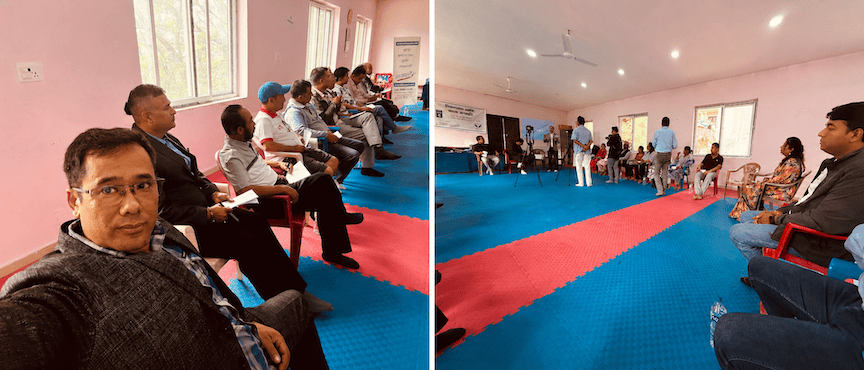
Today, I had the opportunity to participate in an interaction program organized by Tathya Media Group on the theme "Reading Culture for Development." It was a meaningful program. However, one sentence was repeated several times: "Young people today do not read; Nepalis do not have a reading culture."
As I listened, I partly agreed, but I could not fully agree.
If by "reading culture" we mean sitting quietly for a long time with a physical book in hand, then perhaps that habit has declined. There may be some truth in that. But to conclude that "young people today do not read at all" feels too quick and too narrow to me.
Young People Are Reading—But Differently
Because today's children and young people are reading—but not in our style.
They are reading on mobile phones, computers, and tablets. They are reading digital stories, fiction, comics, cartoons, subtitles, captions, online posts, game instructions, chats, comments, articles, information, and both short and long forms of content. In many cases, they are reading faster than us, reading more than us, and reading a wider variety of materials.
When I look at my own two children, I see the same thing. They can finish large books in two or three hours. Sometimes I am the one who has to tell them, "Don't read too much. It may affect your eyes. Your eyes may hurt. Take some rest." It may sound surprising, but many children today do not only need to be told to read; sometimes they also need to be reminded not to read too much.
I see the same pattern among my students. They read everything from diary reports to major novels, stories, fiction, and interesting materials from around the world. When they find content that interests them, they read with deep engagement. Therefore, the claim that "children today do not read" is not true in every case.
We Have Defined Reading Too Narrowly
Perhaps the problem is not that young people do not read. Perhaps the problem is that we have defined "reading" only according to the style of our own generation.
We want them to read in our style, to read the books we choose, to read in the way we prefer, and to read at the pace we expect. But today's generation is reading through different media, at a different speed, with different interests, and in a different world.
So the question is not only, "Why don't young people read?" The more important question is: How are they reading now? What are they reading? Why are they reading it? What kind of medium attracts them?
The Same Problem in Education
We see the same problem in education. We try to teach students on our terms, according to our preferences, and in our style. But effective education begins by understanding the world of the learner. We should not reject the way students are reading; we should understand it, refine it, and guide it toward deeper learning.
A Deeply Rooted Habit in Nepali Society
There is a deeply rooted habit in Nepali society: we see problems more quickly than we see possibilities. We are quick to create negative narratives such as, "There is no reading culture," "Young people are spoiled," or "Children these days are not the same." But we often lack the patience to observe what these same children are reading, how they are learning, and how fast they are moving forward.
What Reading Culture Actually Needs
In my view, developing a reading culture requires more than lectures. It requires a positive environment and a reward system. When a child reads, we should visibly appreciate, honor, and encourage them. We should give them opportunities to present, certificates, book discussions, storytelling platforms, small rewards, and encouragement. Habits grow where people see value.
A Change of Perspective
So my reflection is this:
The reading culture is not dead. The medium of reading has changed. Young people are not refusing to read; they are simply not reading in our style. Now is the time not to blame them, but to understand how they are reading.
When will this negative narrative among Nepalis end? We must learn not only to say "there is no reading culture," but to see that "there is a reading culture—it simply exists in a different form."
To develop a reading culture, our perspective must first change. Only then can we lovingly guide the new generation from digital shallowness toward the depth of books, ideas, reflection, and knowledge.